

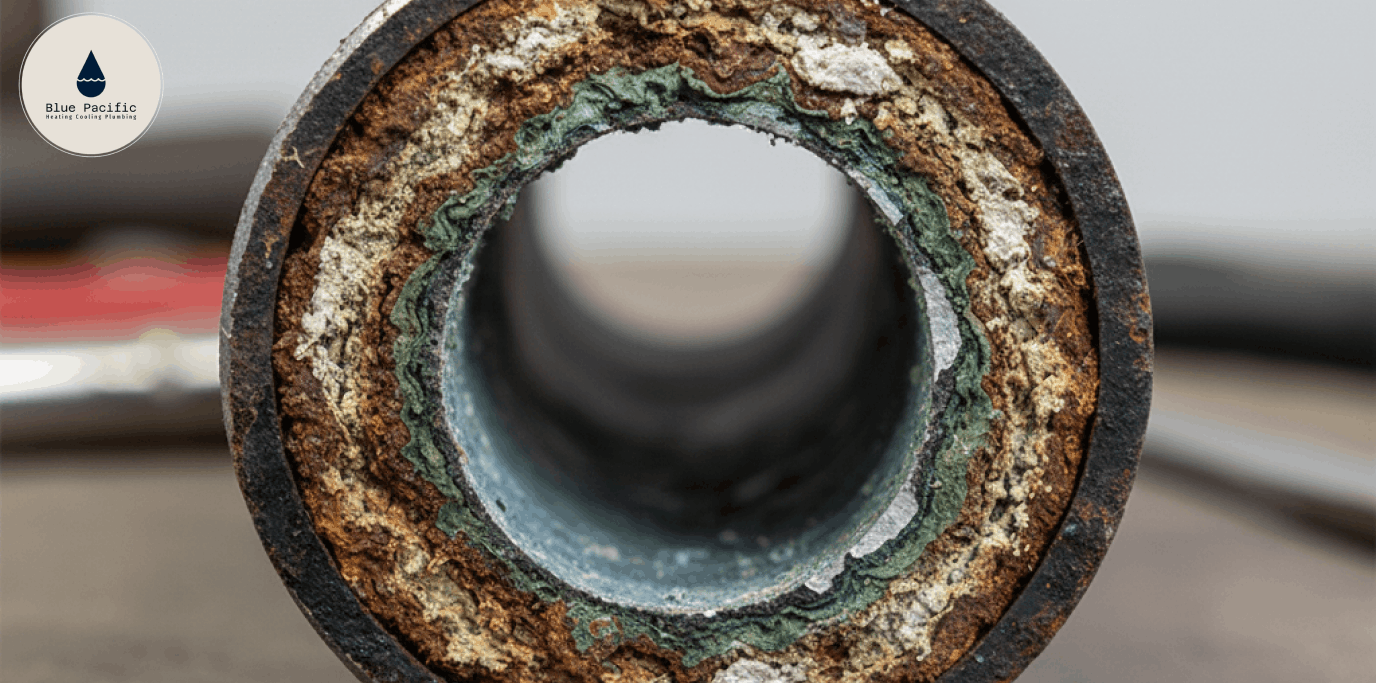
Low water pressure in a house typically results from mineral buildup in older pipes, a failing water pressure regulator, or shut-off valves that are not fully open. Other common culprits include hidden plumbing leaks and issues with the municipal water supply. When water flow drops suddenly, it often points to a mechanical failure or a localized blockage within the plumbing system.
Understanding these causes requires a look at how water moves through a residential system. This article provides a detailed examination of the physical and mechanical factors that restrict water flow, offering technical clarity for homeowners managing these issues. Blue Pacific Cape Cod provides this information based on extensive field experience maintaining complex residential plumbing networks.
Mineral Buildup and Pipe Corrosion
Older homes often feature galvanized steel pipes that are prone to internal corrosion. Over several decades, the zinc coating on these pipes wears away, allowing rust to form on the interior walls. This rust creates a rough surface that catches minerals and sediment, eventually narrowing the diameter of the pipe. As the opening shrinks, the volume of water that can pass through the pipe decreases, leading to a noticeable drop in pressure at the faucet.
Copper and PEX piping are less susceptible to rust, but they are not immune to mineral deposits. Homes with hard water often experience calcium and magnesium buildup inside the lines. According to the Water Quality Association, hard water affects a large portion of households and can cause significant scale accumulation in pipes and appliances. This scale acts like a physical barrier, restricting the flow of water similarly to a clogged artery.
Bonus Tip
To determine if mineral buildup is the cause, compare the pressure of hot water versus cold water. If the hot water pressure is significantly lower, the issue likely resides in the water heater or the hot water lines where sediment settles more frequently.
Malfunctioning Pressure Regulators
A water pressure regulator, or pressure-reducing valve, is a bell-shaped device usually located where the main water line enters the house. Its job is to slow down the high-pressure water coming from the city main to a safe level for home plumbing. Most residential systems are designed to handle 40 to 60 pounds per square inch (PSI).
When this regulator fails, it can either allow too much pressure into the home or, more commonly, restrict the flow almost entirely. A sudden, house-wide drop in pressure is a frequent symptom of a failing regulator. Replacing this component requires specific tools and a clear understanding of the plumbing layout to ensure the new valve is calibrated correctly.
Partially Closed Shut-Off Valves
A house has two main shut-off valves. One is the street-side valve located at the water meter, and the other is the house-side valve where the main line enters the building. If either of these valves is even slightly turned toward the closed position, the water flow into the house will be limited.
This often happens after recent repairs or renovations. A contractor might turn the water off and fail to reopen the valve completely when finished. It is also possible for older gate valves to fail internally; the handle may turn, but the internal gate remains stuck in a partially closed position.
| Component | Common Issue | Effect on Pressure |
|---|---|---|
| Galvanized Pipe | Internal Rust | Gradual decrease over years |
| Pressure Regulator | Mechanical Failure | Sudden house-wide drop |
| Main Valve | Partially Closed | Immediate, consistent low flow |
| Faucet Aerator | Sediment Clog | Low pressure at one specific sink |
| Main Water Line | Hidden Leak | Dropping pressure with rising water bills |
Leaks within the Plumbing System
A leak acts as a diversion for water. If a pipe is cracked or a fitting is loose, a portion of the water intended for your shower or kitchen sink escapes before it reaches its destination. Small leaks might not cause a noticeable drop in pressure, but large ones certainly do.
A report from the Environmental Protection Agency shows that the average household’s leaks can account for nearly 10,000 gallons of water wasted every year. If the low pressure is accompanied by damp spots on walls, ceiling stains, or an unusually high water bill, a leak is the probable cause. Finding these leaks quickly is necessary to prevent structural damage to the property.
Municipal Water Supply Issues
Sometimes the problem originates outside the home. If a water main breaks in the neighborhood, the city may redirect water or lower the pressure while repairs are made. Additionally, during times of high demand, such as early morning when many households are showering or watering lawns, the municipal system might struggle to maintain consistent pressure.
Research by the American Water Works Association indicates that aging municipal infrastructure often leads to unexpected service interruptions and pressure fluctuations. If neighbors are experiencing the same issue, the problem is likely with the city supply rather than the individual home.
Things to Consider Before Making a Decision
Before attempting any repairs, it is helpful to identify if the issue is isolated or widespread. Testing multiple fixtures can narrow down the search. If only the kitchen faucet has low pressure, the aerator is likely clogged with grit. If every fixture in the house is affected, the problem is further up the line, such as the main valve or the regulator. Additionally, documenting when the pressure drops occur can help identify patterns related to municipal demand or mechanical failure.
It is also useful to check the age of the plumbing. Homes built before the 1960s that have not been repiped likely contain galvanized steel. If these pipes are present, simple fixes might only provide temporary relief, and a full system upgrade may be the only permanent solution. Research by Angi suggests that replacing a main water line can cost homeowners between $1,500 and $5,000 depending on the length and material.
Pro Tip
Use a simple pressure gauge that screws onto an outdoor hose bib. This provides an accurate PSI reading of the home’s water pressure. A reading below 40 PSI confirms a system-wide issue that needs attention.
Common Questions About Water Pressure
Many homeowners wonder if a new showerhead can fix low pressure. While high-efficiency showerheads can improve the feel of the water stream, they cannot compensate for a lack of volume coming from the pipes. If the underlying PSI is low, the showerhead will still underperform.
Another common question involves the water heater. Sediment often collects at the bottom of the tank, which can block the hot water outlet. Flushing the water heater once a year helps prevent this sediment from entering the hot water lines and reducing pressure throughout the house.
Direct Questions About Water Pressure
Does a water softener cause low pressure?
Yes, if the resin bed inside the softener becomes saturated or clogged with sediment, it can restrict water flow. Many units have a bypass valve that allows you to test the pressure without the softener in the loop.
Can a clogged filter reduce pressure?
Whole-house filtration systems require regular cartridge changes. A dirty filter acts as a physical barrier. If the filter is not replaced according to the manufacturer’s schedule, the pressure will drop as the filter becomes increasingly obstructed.
Why does my pressure drop when two things are running?
This usually indicates that the main supply line is too small or restricted. The pipe cannot deliver enough volume to satisfy two fixtures at once. This is common in older homes with 1/2 inch main lines instead of the modern 3/4 inch or 1 inch standards.
Is low pressure always a sign of failing pipes?
Not necessarily. While aging pipes are a common cause, simpler issues like a partially closed shut-off valve under a sink or a clogged aerator can produce similar symptoms. Always rule out these accessible components before concluding that the main lines require replacement.
Evaluating the Situation
Restoring water pressure requires a systematic approach to identify the root cause. Start by checking the simplest components, such as faucet aerators and shut-off valves. If the issue persists across all fixtures, investigate the pressure regulator and look for signs of leaks. Understanding the age and material of the plumbing system helps in determining if the fix is a simple part replacement or a more involved system upgrade.
Professional Support for Your Home
When home plumbing systems fail to provide adequate flow, professional diagnostic tools can find the exact location of the restriction. For residents on the Cape needing technical assistance or a system evaluation, Blue Pacific Cape Cod is available to help. Direct inquiries regarding pipe inspections or pressure regulator testing can be sent to Blue PacificCapeCod@gmail.com or by calling (508) 274-9939 to speak with a specialist.
Sources
- Water Quality Association – Provides technical information on hard water and mineral scale accumulation in residential plumbing.
- Environmental Protection Agency – Offers data on residential water leaks and the impact of water waste on household systems.
- Angi – Provides market data on the costs and requirements for replacing residential water lines.
- American Water Works Association – Offers resources on municipal water infrastructure and its impact on residential water delivery.